

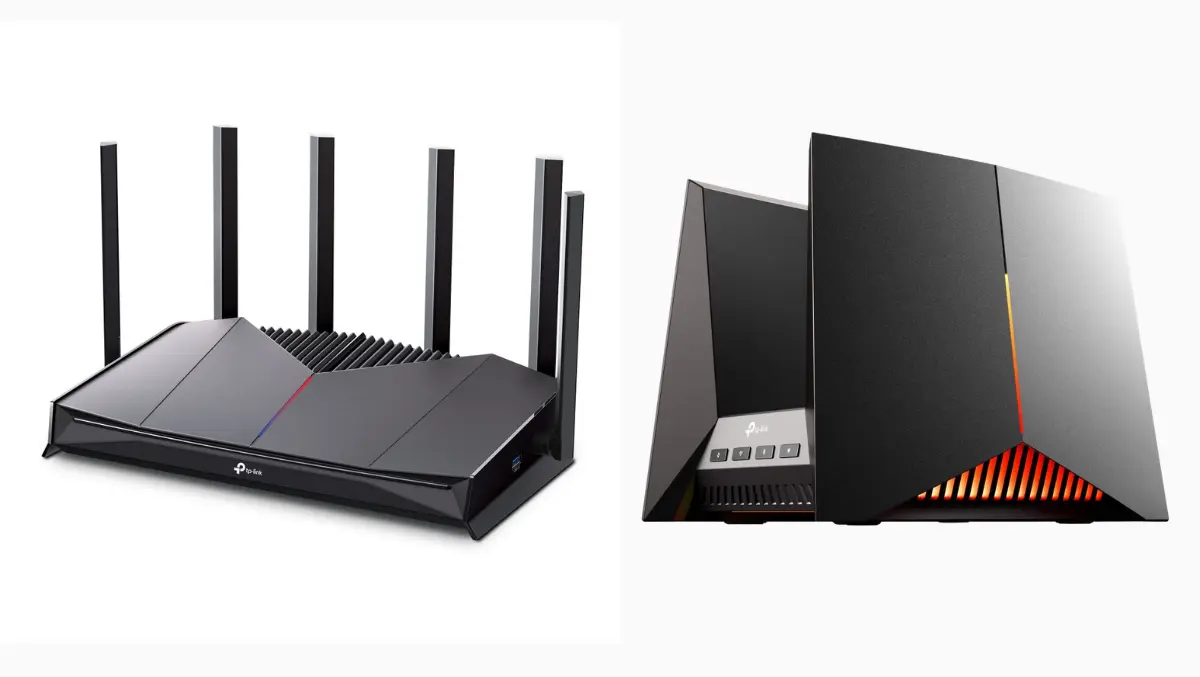
Tp-Link launches Wi-Fi 7 gaming routers from AUD $279
Sun, 29th Mar 2026.webp)
TP-Link Australia has launched its Archer Gaming Router range, with Wi-Fi 7 models priced from AUD $279 to AUD $1,099.
The range targets households where gaming competes for bandwidth with streaming, video calls and connected home devices. At the centre of the launch is the Archer GE550, priced at AUD $599.
The GE550 is a tri-band Wi-Fi 7 router with claimed combined speeds of up to 9220 Mbps. It includes a dedicated 5 GHz gaming band designed to separate gaming traffic from other activity on the home network.
The router also supports Multi-Link Operation across the 6 GHz and 5 GHz bands, allowing simultaneous dual-band connections. Its wired setup includes two 5 Gbps ports, one for WAN and one for LAN, along with three 2.5 Gbps LAN ports.
Other features include a game panel for real-time network monitoring, built-in HomeShield security tools, EasyMesh support for broader household coverage, and adjustable RGB lighting. TP-Link says the model uses an upper and lower heat sink design to manage heat during extended use.
Range details
Above the GE550 is the Archer GE800, priced at AUD $1,099 and positioned as the top-end Wi-Fi 7 option in the series. TP-Link lists it as a BE19000 tri-band model.
Below it is the Archer GE400 at AUD $399, a BE6500 dual-band Wi-Fi 7 router. The Archer GE230, priced at AUD $279, is the entry-level Wi-Fi 7 model in the range and is aimed at smaller setups.
TP-Link has also kept a Wi-Fi 6E option in the portfolio with the Archer GXE75 at AUD $249. It is an AXE5400 tri-band router for buyers not ready to move to Wi-Fi 7.
The new products are designed for modern gaming workloads, where stable connections and traffic management are central to performance. The launch also reflects a broader push by networking vendors to position Wi-Fi 7 as a practical upgrade for homes with multiple connected devices.
Gaming routers have become a more distinct segment of the home networking market as online multiplayer play, cloud-based services and high-resolution streaming place greater demands on domestic broadband equipment. Manufacturers have increasingly focused on traffic prioritisation, lower latency and faster wired connections as key differentiators.
Wi-Fi 7 products are also entering the market across a wider range of price points than earlier generations, as vendors look to broaden adoption beyond premium buyers. TP-Link's Archer pricing spans flagship and entry-level tiers, suggesting an effort to reach both dedicated gamers and households considering a network refresh.
TP-Link notes that maximum wireless speeds are theoretical figures based on IEEE 802.11 specifications, and that actual throughput and coverage will depend on network conditions, client hardware, building materials and environmental factors. Wi-Fi 7 features such as Multi-Link Operation, 320 MHz channels, 4K-QAM and MU-MIMO also require compatible client devices.
Some advanced HomeShield features require a paid subscription, while game acceleration performance may vary by application and network environment.
"Gaming is no longer just another use case in the home, it's one of the most demanding," said Neville Wang, Managing Director, TP-Link Australia and New Zealand. "We've built this lineup to give every type of gamer, from the weekend player to the serious competitor, a router that actually prioritises their game."