

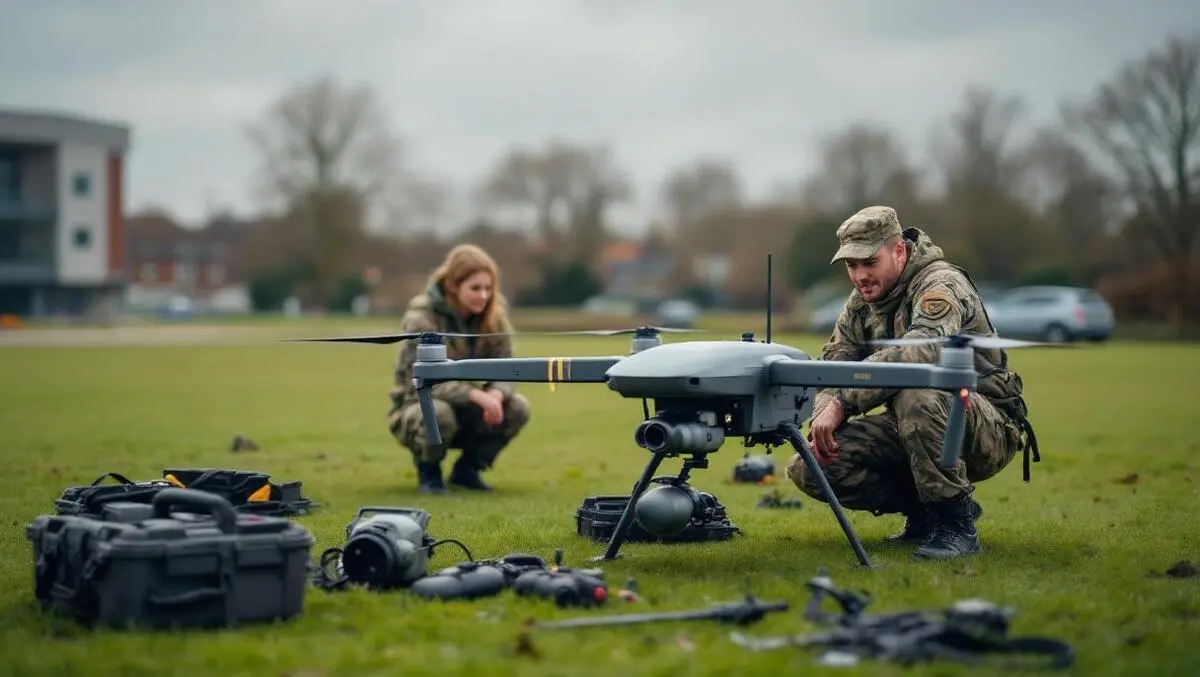

The New Model Institute for Technology and Engineering has agreed a new partnership with the British Army to create a three-year drone-focused engineering degree, as the UK military increases investment in autonomous and uncrewed systems.
The undergraduate programme in autonomous systems will admit its first students in September 2026 and will run on an accelerated timetable. Graduates will receive a Master of Engineering after three years of study rather than the four years that is common at traditional universities.
NMITE will deliver the degree using its project-based teaching model. Students will work on practical challenges rather than attend conventional lectures or sit formal exams.
The programme will centre on drone and autonomous technologies. NMITE plans broad training in engineering fundamentals. It will also provide specialist study in the design, construction and operation of uncrewed systems.
The initiative links defence skills needs with regional development goals. It aligns with themes highlighted in the UK Government's Industrial Strategy and recent defence reviews, which have called for faster development of technical skills and stronger economic impact in less prosperous areas.
Minister for the Armed Forces Al Carns said the new programme reflects a shift in the UK's defence posture.
"We are in a new era of threat, which demands a new era for defence skills. Our Armed Forces must have the skills and experience to tackle the modern-day threats head on - including with engineers who can design, build and operate cutting-edge drone technology to defend our country. Through our Strategic Defence Review we are doubling investment in autonomous and uncrewed systems this parliament, putting the UK at the leading edge of innovation in NATO, and training a new generation to keep Britain secure at home and strong abroad."
The British Army is backing the degree as a route to new technical expertise around autonomy and uncrewed platforms. The support underlines the armed forces' growing focus on drones for surveillance, logistics and combat roles.
Chief of the Defence Staff, Air Chief Marshal Sir Richard Knighton, said the skills agenda now sits at the centre of defence planning. "Developing skills in autonomous technologies is critical to both defence and the Army. Backed by the British Army, NMITE will train the next generation of drone warfare specialists and help make the Army more lethal in an increasingly dangerous world," said Knighton.
The Hereford-based institute plans to frame drones as dual-use tools rather than solely as military equipment. The curriculum will draw on potential applications in infrastructure inspection, delivery and logistics, environmental monitoring, emergency response and humanitarian operations.
NMITE President and Chief Executive James Newby said the institute intends the degree to meet national needs across sectors. "This partnership demonstrates NMITE's unique ability to move quickly to meet national skills needs. We are proud to be shaping this innovative new degree in Autonomous Systems, one that will not only serve defence priorities but also unlock enormous civilian and humanitarian benefits," said Newby.
The institute has enrolled more than 220 students since it began teaching and now works with over 80 industry partners. It uses purpose-built facilities in Hereford and runs a range of integrated engineering and construction-related degrees.
New academic lead
NMITE has appointed Professor Alexandru (Alex) Stancu as Professor of Mechanical Engineering and Academic Lead for the autonomous systems degree. He will oversee the design and delivery of the new programme.
Stancu has more than 25 years of international experience in robotics, artificial intelligence and autonomous systems. He previously led the Robotics and Autonomous Systems Research Group at the University of Manchester and founded Manchester Robotics. His work covers both research and deployment of drone and autonomous vehicle technologies in defence and civilian settings.
According to NMITE, Stancu has secured more than GBP £10 million in funding over his career. He has contributed to projects that advance theoretical work on autonomy and its use in industrial and operational environments. Robotics and AI curricula that he developed are now in use at universities in the UK and overseas.
The institute describes the new degree as a further test of its applied teaching model. Students will work on real-world problems sourced from defence and industry partners. The focus will sit on systems that combine hardware, software and data, including sensing, navigation and control for uncrewed platforms.
Regional focus
Local political leaders view the degree as part of a wider shift in Herefordshire's economy. The region has attracted increased defence-related activity and technology investment in recent years.
Jesse Norman, Member of Parliament and Chair of NMITE, said the initiative would reinforce that trend. "This degree marks an important step forward for NMITE. It will create huge opportunities for our students, bring significant investment into Herefordshire, and support the county's new defence ecosystem, for the benefit of local people and businesses, and the nation as a whole," said Norman.
NMITE said it will take expressions of interest from prospective students ahead of the 2026 intake. It plans further announcements on detailed course content, industry projects and bursary arrangements as the launch date approaches.