


Delta has launched a prefabricated modular data centre system for AI workloads that it says can cut deployment time by up to 60%.
The product is part of the Taiwanese technology group's broader push into infrastructure for large AI data centres, including direct current power systems, liquid cooling and microgrid equipment designed to handle rising power demand.
The prefabricated system combines power, cooling, piping and IT infrastructure into factory-built units that are assembled and tested before delivery. Delta is also offering a containerised version that integrates uninterruptible power supply systems, IT equipment and cooling in a single unit.
The modular approach is intended to shorten construction cycles as AI facility operators face pressure to bring new capacity online quickly. Delta says the containerised model fits into a footprint equivalent to a single parking space and can keep power usage effectiveness below 1.19.
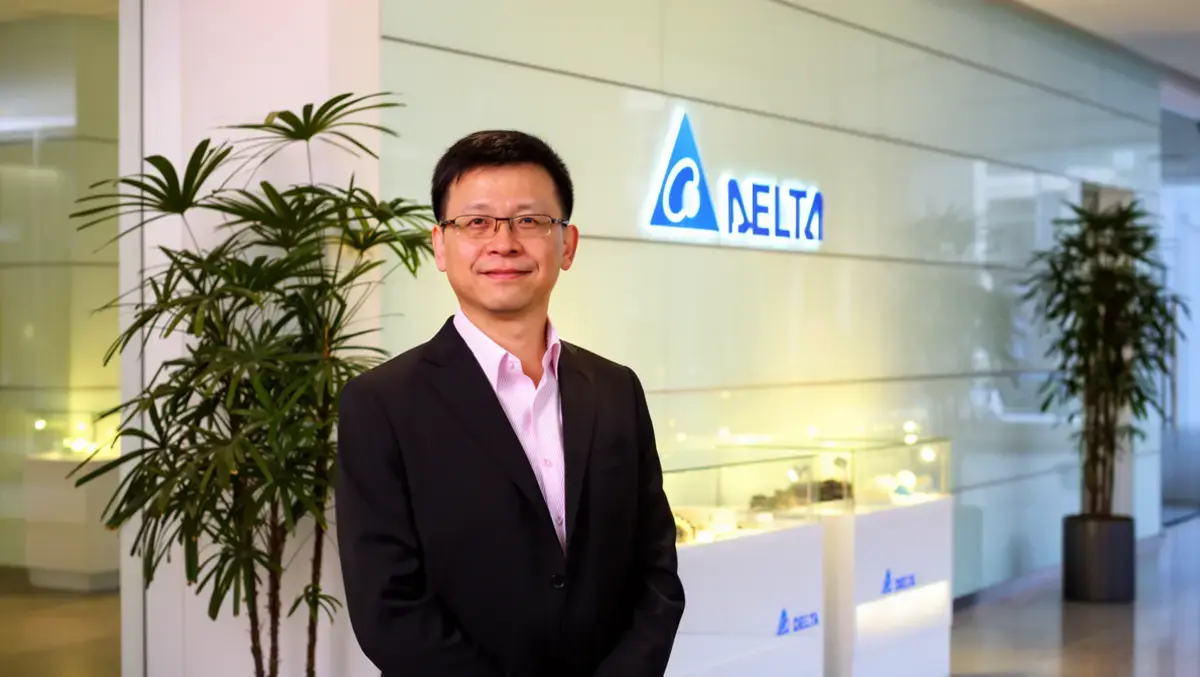
Kelvin Huang, Vice President and General Manager of Delta's ICT Infrastructure Business Group, said: "Traditional data center construction models can no longer meet the stringent speed and high-density requirements of the AI era. The prefabricated data center showcased this year streamlines complexity through a modular design. By completing pre-assembly and testing at the factory, the deployment time is reduced by as much as 60%, allowing enterprises to bring computing power online in the shortest time possible. Furthermore, it significantly reduces PUE, providing customers with a high-efficiency, sustainable, and scalable foundation for AI computing."
Power shift
Alongside the modular system, Delta is highlighting an 800VDC in-row power design and liquid cooling systems for dense AI racks. Its latest in-row unit can deliver up to 660kW of output and 480kW of backup power.
The focus on high-voltage direct current reflects a wider debate in the data centre sector over how to support racks with rapidly rising electricity and cooling requirements. Suppliers are increasingly exploring alternatives to conventional AC-DC layouts as AI servers draw more power and generate more heat.
Ares Chen, Vice President and General Manager of Delta's Power and System Business Group, said: "With the rapid evolution of AI and high-density computing, traditional AC-DC power architectures are expected to reach their limits within the next one to two years. High-voltage DC designs centered on HVDC have emerged as a critical solution to minimize distribution losses and maximize energy efficiency. Delta leads the industry with our comprehensive 'Grid-to-Chip' solutions. Our latest 800VDC In-Row Power Solution enables flexible deployment of power and battery backup modules directly within the rack. This approach optimizes space and cooling while bolstering system resilience and scalability-establishing the essential power foundation for the future of AI computing."
Its thermal systems under the HVDC design range from row-level cooling to chip-level cooling. They include a 2.4MW liquid-to-liquid cooling distribution unit with N+1 redundancy and hot-swappable pumps, as well as a new cold plate for NVIDIA Vera Rubin NVL72.
For air-cooled systems, Delta has also introduced HVDC fans that it says improve efficiency at full load and lower load levels. Other hardware on show includes power shelves for 19-inch and 21-inch racks, power distribution boards and liquid-cooled busbars designed for high-current loads.
Beyond data centres
Delta is also linking its data centre push to software-based industrial and building applications built with NVIDIA Omniverse libraries. These include digital twin systems for production lines and building automation.
In manufacturing, its Line Manager and DIATwin systems are already in use on AI server power supply production lines at Delta's plant in Thailand. The aim is to model processes in a virtual environment before applying changes on the factory floor.
For buildings, the same approach can be used to anticipate environmental changes and adjust heating, ventilation, air conditioning, shading and lighting. Delta says this can deliver energy savings of 20% while maintaining indoor comfort.
Ping Cheng, Chairman and Chief Executive Officer of Delta, said: "As the scale of AI data centers continues to increase, the resulting massive power demand poses significant challenges to conventional power grids. Energy efficiency and power stability improvements have become top priorities, accelerating the adoption of microgrids. Leveraging years of deep technical expertise in power, thermal management, and infrastructure, Delta's innovative solutions are uniquely positioned to address the high efficiency, energy resilience, and rapid deployment demands of our customers' large-scale AI cloud and enterprise data centers."
Shan-Shan Guo, Chief Brand Officer of Delta, said: "The widespread adoption of AI is expanding the demand for eco-friendly and innovative infrastructure across a plethora of industries. This is why we are presenting at COMPUTEX this year a broad spectrum of solutions for diverse scenarios-from prefabricated solutions that accelerate the deployment of AI computing power to physical and edge AI applications where AI extends beyond data centers and into factories, buildings, and transportation. On Delta's 55th anniversary, we remain committed to advancing a new era of sustainable AI alongside our worldwide partners through our leading-edge portfolio of smart, energy-saving solutions."