

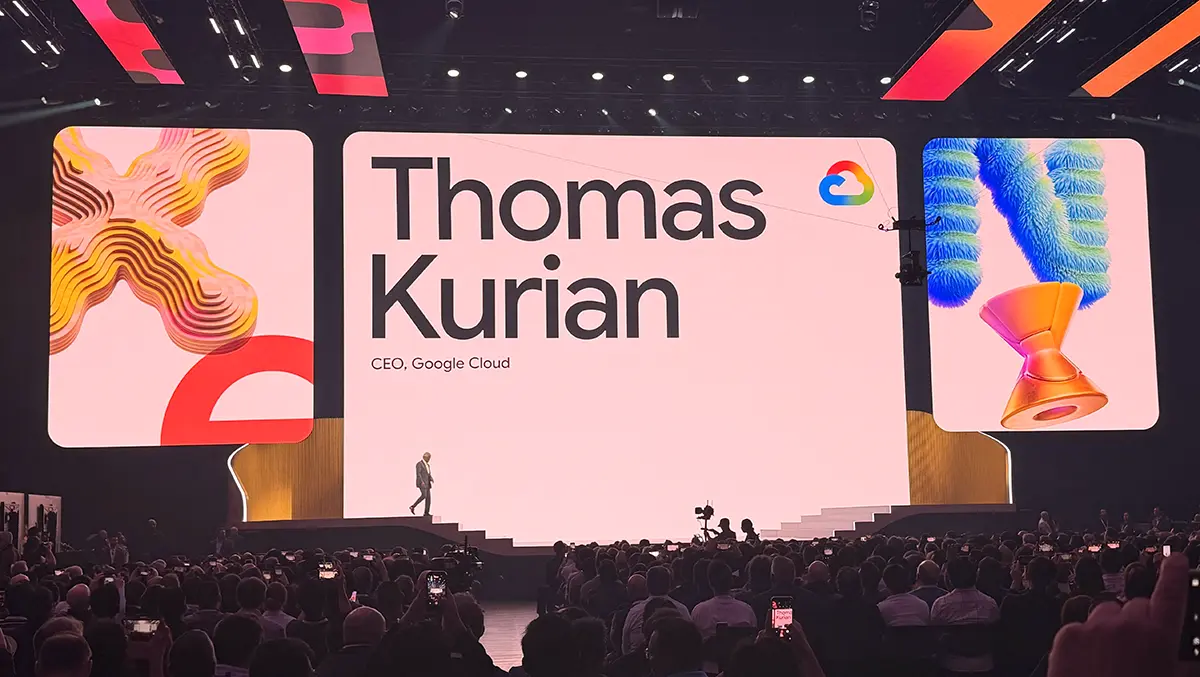
Google Cloud CEO sets out enterprise AI agent plan
Tue, 28th Apr 2026
Google Cloud is positioning Gemini Enterprise as a control layer for corporate AI agents, with chief executive Thomas Kurian saying the company's advantage lies in combining models, infrastructure, data, security and workplace tools in one platform.
Full stack
At Cloud Next, Google framed the next phase of enterprise AI around agents that can use data, tools and software systems to complete business tasks. Gemini Enterprise is now pitched as an end-to-end system for the "agentic era", spanning AI infrastructure, data, defence, agent development and pre-built specialist agents.
The announcement reflects a wider shift among cloud providers from selling access to models to offering managed AI operating environments. Google Cloud says the platform expands on Vertex AI and is intended to help businesses build, govern and optimise agents with controls similar to those used for mission-critical software.
"To optimise the whole stack, from compute to how efficiently we are running agents, how the agents can access tools, that vertical integration is truly unique and different from anyone else in the market. If you look at any other hyperscaler where they don't have their own models, they don't have their own chips. And if you look at an AI lab, they typically say you can use our models, but then you have to figure out security, you have to figure out the data platform and the tools that are used. So there's differentiation in the breadth of the stack. At the same time, we don't expect the company to use everything from Google. So even as we integrated more pieces of it, we've kept the architecture open," said Thomas Kurian, CEO, Google Cloud.
Google said Gemini 3.1 Pro is available in preview for complex workflow orchestration. Gemini 3.1 Flash Image, Veo 3.1 Lite and Lyria 3 Pro are also in preview. The platform also supports Anthropic models including Claude Opus, Sonnet and Haiku, with Claude Opus 4.7 being added.
Agent controls
Governance is central to the pitch. The Gemini Enterprise Agent Platform includes Agent Studio for low-code agent creation, an agent registry, a skills and tools registry, an agent marketplace and support for Model Context Protocol.
Google is also adding agent-to-agent orchestration, zero-trust verification, Agent Identity, Agent Gateway, Model Armor and observability features using OTel-compliant telemetry. These tools are designed to help enterprises trace agent activity, apply policy controls and diagnose issues such as reasoning loops or improper tool use.
Kurian said the platform is designed to work across Google Workspace and Gemini Enterprise rather than sit in a separate AI console.
"One example is you can start a task in Gemini Enterprise and complete that task in Workspace. So for example, we showed Canvas mode where Gemini Enterprise creates a slide deck, and then you can continue and finish that slide deck. Or you can ask the research agent to run a complex analysis, create a spreadsheet, and then the user can continue using that in Workspace using Gemini Workspace for complex calculations," added Kurian.
Microsoft 365 interoperability will allow documents and slides created within Canvas to be exported into common Microsoft Office formats. Workspace Intelligence can also use meeting context and other signals, not only documents in Drive, to help users find information.
Data links
For enterprises, agentic AI depends on access to business systems beyond a single productivity suite. Kurian said Google is building connectors itself and supporting customers that need to link bespoke systems.
"We are building connectors. We have over 100 already available, including four types of systems, document repositories, so Box, Dropbox, SharePoint, Microsoft Office, we build those connectors. Second, SaaS applications, Workday, ServiceNow, Salesforce, Oracle, NetSuite, Intuit, there's a whole range, depending if you're an upmarket, large enterprise customer versus a small and medium business. Third is databases, Oracle, Databricks, Snowflake, a variety of them. We also build connectors to those organisations," added Kurian.
He said Google also supports a connector framework and standards such as Bring Your Own MCP, allowing companies to connect bespoke systems.
During the keynote, Google cited several enterprise use cases. Citi Wealth unveiled Citi Sky, an AI-powered member of its wealth team. Honeywell is using digital twins trained on more than one million product specifications. Liverpool expects a 10 times return on investment from a shopping assistant. NASA is using Gemini Enterprise agents for Artemis II flight readiness and astronaut safety.
Other examples included Signal Iduna, Bosch, KPMG, the American Society for Clinical Oncology, Merck and Walmart. Signal Iduna reached 80% adoption within weeks, with 11,000 employees building agents, according to Google. KPMG reached 90% adoption with more than 100 agents in its first month.
Security push
Security is another major part of Google Cloud's AI strategy. Kurian said Vertex AI includes controls to detect distillation patterns, an issue that has become more prominent as model providers seek to protect intellectual property.
"We have controls in the way that we expose the API with our Vertex platform to detect if people are doing distillation. It's an important issue for us, from both an IP protection point of view as well as we don't want bad actors to steal the IP and then use it to attack things, for example, from a cyber point of view. So for years, we've had a lot of capability to detect distillation patterns and protect against it, and so we're quite confident that we have the necessary protections," added Kurian.
Kurian also outlined a broader cyber protection portfolio built around code analysis, threat intelligence and workflow automation. He said Dark Web Intelligence was "98% accurate" in prioritising threats, and pointed to Wiz as part of Google's plan to automate testing and remediation.
"We have a broad portfolio that we're bringing to customers as early as next week for cyber protection. So as models have gotten much better understanding code, we realised that quite some time ago that cyber security actors will use models to analyse code, find vulnerabilities and use that to attack," added Kurian.