


NEC & NYU value flood defences at USD $800 million
Tue, 26th May 2026
NEC and New York University have evaluated the economic impact of flood protection work around Manhattan, finding that avoided losses could reach about USD $800 million.
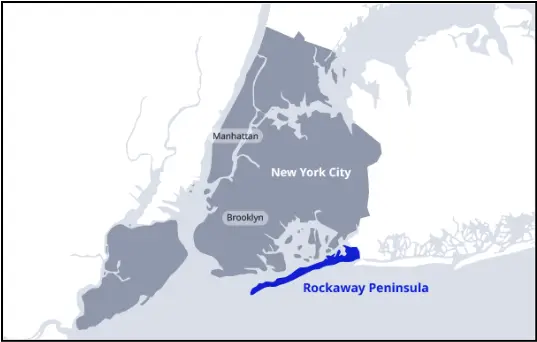
The study focused on New York City's Rockaway Peninsula, examining how flood defences affect transport, housing, mental health and other parts of the local economy. NEC and NYU also signed a memorandum of understanding to expand joint work on urban disaster prevention, resilience and advanced technology.
The research was carried out through the Capstone Program at the NYU Tandon School of Engineering, where students and researchers worked with NEC on digital adaptation finance for urban resilience. The goal was to develop a way to value projects whose benefits are spread across several sectors and are difficult to capture through standard return-on-investment measures.
That challenge has become more urgent as cities face greater climate-related risks and as public and private funders seek clearer evidence to support resilience spending. Flood protection schemes can reduce direct physical damage, but also secondary losses linked to disruption, relocation and broader social harm.
How it was measured
Researchers built value analysis models across five themes identified as having the strongest effects. These included transport infrastructure, housing and mental health, as well as protection of tourism resources through measures to prevent beach erosion.
The analysis drew on data from past hurricanes, including Hurricane Sandy, along with projected flood damage under future risk scenarios. Using geographic information systems, the team combined flood hazard information and damage scenarios with spatial and economic datasets covering land use, taxation, demographics and mapping.
By linking these datasets, the researchers mapped where flooding would occur, which communities and assets would be exposed, and how losses would spread through the surrounding economy. The exercise converted avoided damage, potential losses and newly created value into monetary estimates.
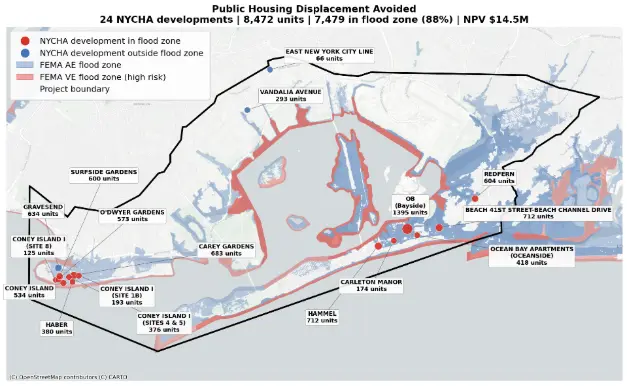
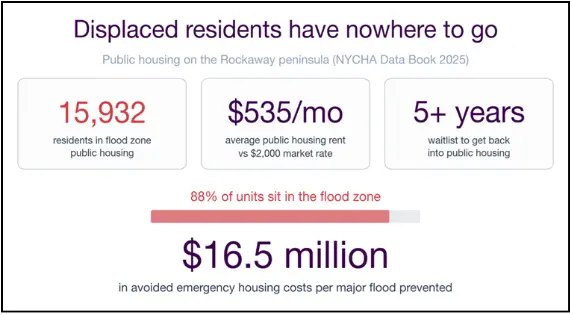
One example in the study found that, without flood countermeasures, 88% of public housing units in the area would be at risk of inundation. The project also assessed the economic value of avoiding forced relocation or rebuilding after flooding.
To test the findings, the estimated results were compared with past cases and existing academic research. The work also included interviews with local stakeholders and residents about conditions before and after flood protection measures, along with input from financial institutions on how such projects are assessed in impact finance and investment practice.
Funding questions
The broader issue behind the project is how to finance resilience measures that deliver wide public benefits but lack straightforward commercial payback. NEC has been applying value chain modelling and digital tools to areas such as disaster preparedness, preventive maintenance, sustainability and business continuity planning, where outcomes are often hard to quantify.
For financial backers, the challenge is less about recognising climate risk than assigning a robust value to mitigation. A framework that puts a monetary figure on avoided losses could help projects secure support from a wider range of lenders and investors.
Under the new agreement, NEC and NYU plan to study how quantified economic impacts could support different financing methods. Areas under discussion include the use of satellite image analysis, artificial intelligence and remote sensing in project evaluation.
The collaboration also reflects a broader effort by universities and companies to link climate risk research with practical infrastructure decisions. New York's coastal resilience planning has taken on greater urgency since Sandy exposed how local flood events can trigger knock-on effects across transport networks, housing and community wellbeing.
The Greater Rockaway Resilience Plan, under way since 2020, includes dune construction, shoreline reinforcement and seawall development. The latest economic assessment was designed to measure the wider benefits of that package, not just its direct engineering outcomes.
Yuki Miura, Assistant Professor in the Department of Mechanical and Aerospace Engineering and the Centre for Urban Science and Progress at the NYU Tandon School of Engineering, chair of the Climate, Energy, and Risk Analytics Lab, and member of the New York City Panel on Climate Change, described the approach behind the work.
"'Where, to whom, and how much damage cascades' is the foundational question of CERA Lab. In this study, we spatially integrated flood hazard data and socioeconomic data spanning transportation, housing, and mental health in New York City's Rockaway Peninsula, and quantified the multifaceted benefits generated by disaster prevention investments. These benefits have historically been invisible, resulting in their omission from investment decisions. This research provides a framework to fill that gap. Visualizing these invisible benefits has the power to drive policy and funding decisions, not just academic research. Through my work on the New York City Panel on Climate Change (NPCC) I engage daily with the process by which climate change impact assessments are reflected in urban policy. This research was also designed from that perspective, and I find it highly significant that, through collaboration with NEC, we were able to demonstrate how an academic framework can expand the possibilities of real-world project evaluation and funding," Miura said.
Ryutaro Adachi, Executive Professional in NEC's GX Business Development Division, said the work addresses a recurring problem in climate adaptation spending.
"The economic damages associated with climate change are, in fact, most pronounced in developed countries. While strengthening resilience is urgent, public and private sectors efforts often remain fragmented, and for individual projects, ROI is often unclear, making decision-making and fundraising difficult. This research presents a basic framework for evaluating the economic impact of projects with ambiguous effects and suggests the potential for expanding future funding methods. We are pleased to have been able to share our findings in collaboration with NYU, through a project focused on the global city of New York," Adachi said.