

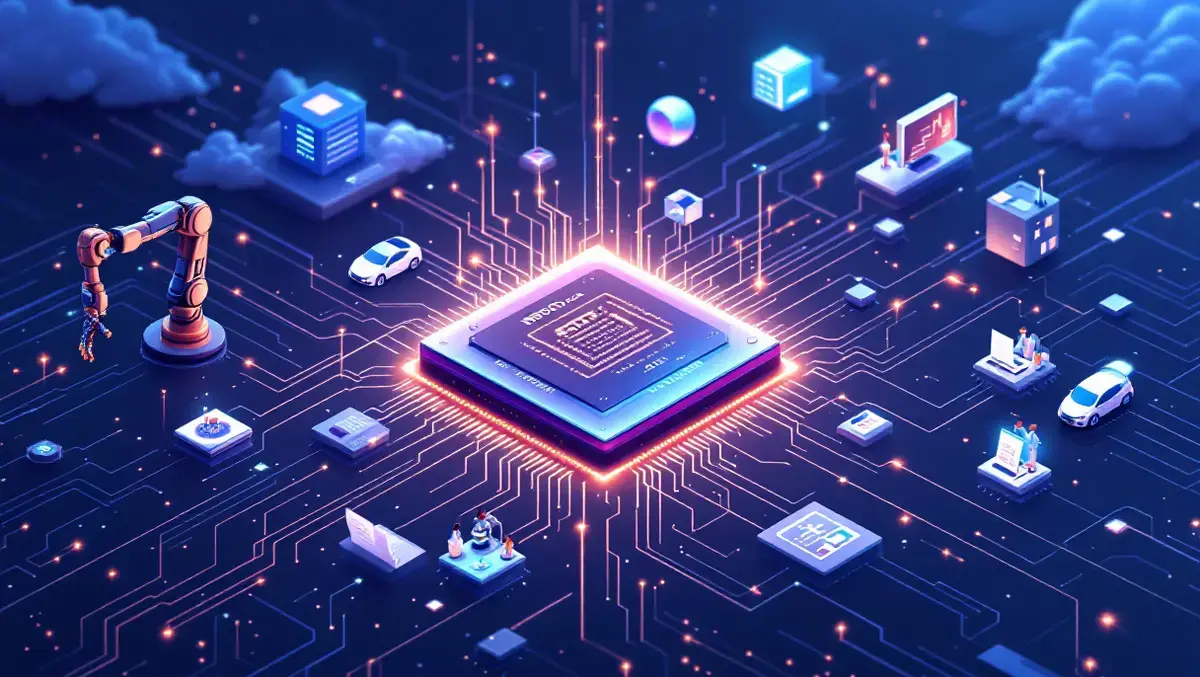

NVIDIA said 74 of its papers were accepted at ICML 2026 and that about 2,000 accepted papers cited its GPUs.
The figures point to NVIDIA's broad presence in this year's machine learning research. Another 145 accepted papers cited Nemotron, its family of open models and datasets, as a foundation for new work. Additional papers drew on its Cosmos, Isaac GR00T and BioNeMo model families in research spanning robotics, autonomous vehicles and biomedical science.
Highlighted research topics included vision and video generation, reinforcement learning for large language models and agent training, and AI inference. Newer areas also gained traction, including robot world models, life sciences research and synthetic data generation.
Research themes
One example was DreamDojo, a paper focused on robot world models. NVIDIA said the work uses Cosmos open models to learn from human video and predict how a robot would handle objects and operate in environments it had not been trained on.
According to NVIDIA, the approach lets researchers evaluate policies, plan actions and teleoperate a virtual robot before physical deployment. That reflects a wider push in AI research to use simulation and generated data to reduce the cost and risk of real-world testing.
In life sciences, BioNeMo-backed research at the conference focused on protein function, molecular behaviour and genetic code. NVIDIA pointed to FLIP2 as a public benchmark for testing how well AI predicts the effects of protein mutations, and to KERMT as a model for predicting molecular properties linked to drug discovery.
Synthetic data also featured strongly in this year's accepted work, with several Nemotron and physical AI open datasets appearing in research. The trend suggests more researchers are looking beyond human-labelled data when building large-scale training sets.
Open stack
NVIDIA framed Nemotron not as a single model but as a broader research stack built around open weights, datasets and methods. Researchers are using those components for reasoning, tool use, safety work, data curation and efficient inference, it said.
NVIDIA also pointed to NeMo Curator as part of that approach, describing it as a reproducible basis for training data curation. In parallel, synthetic data tools are being used to create large training datasets that would have been harder to assemble only a few years ago.
Its Cosmos 3 family is being used in work on robots, autonomous vehicles and vision AI, while Alpamayo, Isaac GR00T and BioNeMo support development in autonomous driving, robotics and biomedicine. The common thread is the use of open models and datasets as starting points for further academic and commercial research.
Wider uptake
NVIDIA also pointed to external groups building on its model families. Basecamp Research developed a DNA foundation model called EDEN to help researchers interpret and design genetic sequences.
Merck uses KERMT to predict how potential drug molecules may behave in the body, including whether they are likely to be effective, safe and developable. In AI model development, Sakana AI built its Fugu and Fugu-Ultra models on Nemotron 3 Ultra, while NAVER developed its own model using the Nemotron architecture for Korean-language research.
Together AI is hosting Nemotron models on its platform, broadening access for researchers seeking open inference tools. NVIDIA also said KiloCode integrated Nemotron into its code-routing architecture and reported token cost reductions of up to 90%, which it presented as relevant to the economics of deploying AI systems.
In robotics, NVIDIA said Humanoid, LG Electronics, NEURA Robotics and Noble Machines are adopting Isaac GR00T models in industrial humanoid work. It added that 1X, Agility, Agile Robots, Boston Dynamics, Hexagon Robotics and Mentee are using Cosmos world models, Isaac Sim and Isaac Lab to develop and validate humanoid robots.
The ICML data offers a snapshot of where AI research is currently concentrating. NVIDIA said open frontier models and open AI infrastructure are becoming foundational to how modern AI science is carried out.