

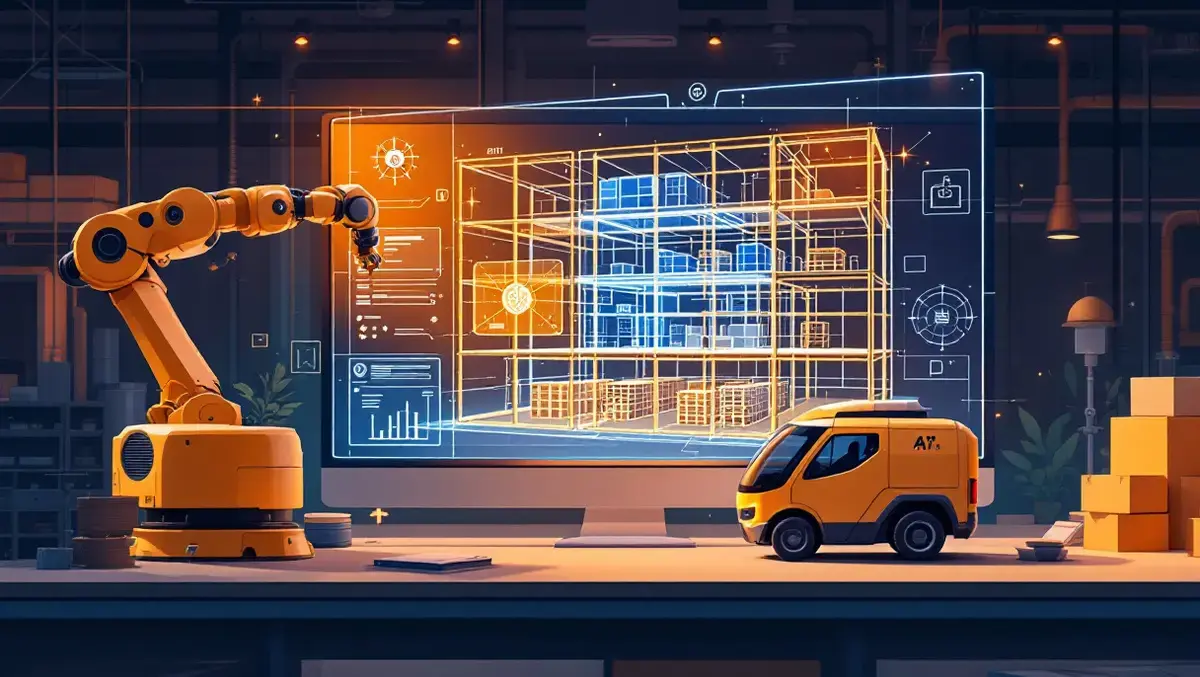
Nvidia shows AI agents building digital twin simulations
Mon, 23rd Nov 2026 (Today)
NVIDIA has outlined a series of developer projects that use frontier AI models with its Omniverse libraries to build simulation applications across industrial digital twins, robotics, virtual reality and autonomous vehicle testing.
The projects are part of a broader push to use natural-language instructions to guide AI agents in assembling assets, linking physics and rendering systems, and checking whether simulated scenes behave as intended.
Across the examples, developers used Omniverse libraries for scene updates, rendering, virtual reality support, physics and browser streaming. They also drew on tools including Isaac Sim, Isaac Lab, OpenUSD, Blender, Houdini and Newton physics.
Industrial twins
One of the most commercially relevant examples came from Falkor, a KONGSBERG company, which built its Falkor Surface platform around the GPT-6 Astra model. The platform lets customers turn computer-aided design and engineering data into facility-scale digital twins and uses Omniverse libraries with NVIDIA RTX PRO 6000 Server Edition GPUs on Microsoft Azure for physics simulation.
Falkor's agentic engine was designed to interpret technical documentation, spatial relationships and real-world physics. Engineers can test plans in simulation before visiting a site and inspect equipment and clearances in a shared view.
Another industrial example was a gas-turbine what-if analysis application built by Pradeep Kaushik from NVIDIA's Omniverse Developer Relations team. The prototype let users adjust variables including load, ambient temperature and fuel composition, then compare the effects on power, efficiency, fuel consumption and equipment response.
The application used tools including Cantera and SciPy, while Omniverse libraries handled scene updates, rendering and browser streaming. Users could rotate and inspect a 3D turbine while reviewing charts and virtual instruments tied to simulated responses.
Robotics work
Several projects focused on robotics simulation and testing. NVIDIA developers Dillon Bailey and Rishabh Chadha used SimReady Central assets to create a pick-and-place simulation in Isaac Sim, where a robot moved a can after an AI agent assembled the scene and generated controls.
The aim was to test how well the components worked together, including joint movement, contact behaviour and the gripper's ability to hold and release the object. Developers could then alter object positions and motion paths and repeat the tests.
In another example, AI developer Maziyar Panahi used Claude Code with Claude Opus 5.5 to assemble an intensive care unit from 13 SimReady hospital assets and test Microduck robots within it. The robots used pre-trained walking policies and followed preset routes through the simulated wards.
The assets already included Newton physics settings, reducing manual preparation. In a run covering 256 wards, 766 of 768 Microducks remained upright after 14 simulated seconds.
There were also examples involving disassembly and flexible cable handling. Jens Jebens, Senior Product Manager for OpenUSD at NVIDIA, used Astra to model a car suspension in PTC Onshape and configure it in Isaac Sim, then revised the tooling based on simulation feedback until a suspension component could be removed in simulation.
Oyindamola Omotuyi, Robotics Technical Marketing Manager at NVIDIA, directed Astra to build a simulation for flexible cable routing and USB-C insertion using Isaac Lab, Newton physics and Omniverse rendering. The work was intended to test cable handling and connector alignment before moving to experiments with a physical robot.
VR and content creation
Outside industrial and robotics uses, developers also used Omniverse libraries in virtual reality and 3D content creation. Community developer Michael Wagner built a voice-controlled VR application that let users search SimReady Central assets by voice and interact with them inside an immersive scene.
The application used separate Omniverse components for shared scene management, rendering, VR support and physics. Wagner later built a second version using a different physics library to compare behaviour. One issue, in which objects shook when grabbed, was fixed by updating the grab control once per frame.
Nick Scarcella, Senior Technical Artist on NVIDIA's BondLab team, used AI agents with Houdini, CUDA libraries and Isaac Sim to create editable animated 3D content. In one experiment, he guided Astra to recreate an OP-1 portable synthesiser from product images and manuals, then refined details across Houdini and Blender before adjusting materials and textures for rendering.
The BondLab team also created an "Echos" visualisation of robot-hand motion, in which translucent versions of a hand overlapped and merged into a single animation.
Scale and testing
NVIDIA also highlighted projects focused on performance and validation. Bhavik Sanganee, Principal Engineer at NVIDIA, used Astra with Omniverse libraries to build and stress-test a warehouse simulation as scene complexity increased.
Performance initially dropped below target when the scene doubled in size, but concurrent handling of physics calculations, image rendering and video preparation restored it. In a two-minute test with 80 conveyors, 40 arms and 800 boxes, the simulation sustained 30 frames per second at full HD resolution and completed 640 successful box placements.
Elsewhere, Ashley Reid, who works on RTX sensor validation at NVIDIA, used Astra and Claude Fable 5 agents to compare simulated camera and LiDAR outputs with recorded data. Over about three days, the agents created two digital twins from scratch and improved two existing ones by addressing missing objects, geometry and materials.
The collection also included a humanoid warehouse simulator, an autonomous-driving test workflow based on San Francisco's Market Street, an International Space Station model brought into a browser with telemetry, and a workflow for reconstructing editable building models from site scans.
Overall, the examples were intended to show how developers can use AI agents alongside Omniverse libraries to turn simulation ideas into working applications, then inspect, revise and test the results.