

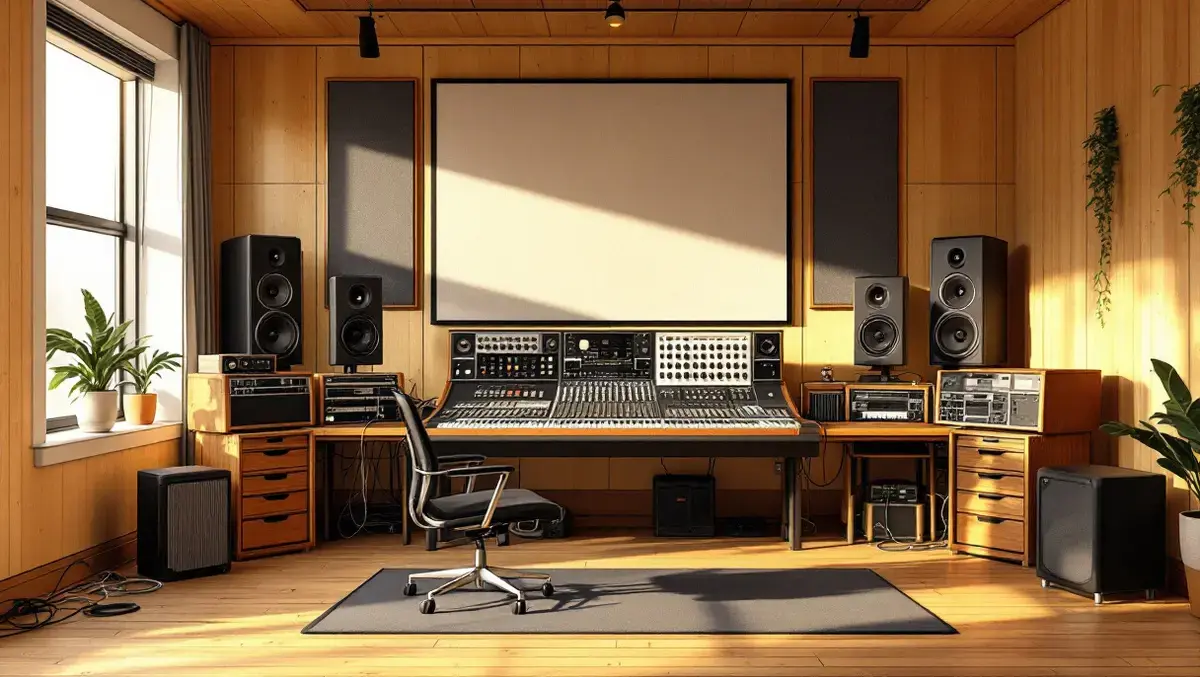
Ryan Lewis renovates Washington studio with Harrison console
Thu, 13th Aug 2026.webp)
Ryan Lewis has renovated his Washington state studio with a Harrison 32Classic console and seven Harrison D510R 500 Series racks. A second 32Classic has also been installed in a Los Angeles studio now under construction.
The Washington facility, previously Lewis's private room, is set to open to outside clients as a commercial studio.
Lewis, who first gained prominence as one half of Macklemore & Ryan Lewis, is expanding his studio footprint on the US West Coast and in Washington state. The upgraded Washington room was completed with Vintage King Audio, which handled the redesign and integration.
The studio centres on a 32-channel analogue inline console from Harrison, paired with a rack-based outboard setup designed to reduce the manual patching typically associated with analogue rooms. Lewis said the desk's integrated conversion and Dante networking were central to the decision.
"I chose the Harrison for the legendary EQs, the crazy filters, the mic pre's, 32 channels, eight buses, the history of the brand and Dave Harrison, who invented the inline console," said Ryan Lewis, producer and musician. "But none of that was why I bought it. Unlike most consoles, there are integrated converters everywhere - the console is a Dante interface. That fundamentally changes what a console can do in a studio."
The 32Classic includes onboard analogue-to-digital and digital-to-analogue conversion, with routing across channels, buses and monitor playback paths through its Dante interface. Lewis said this lets signals be sent into a digital audio workstation while keeping analogue outputs free for other uses in the room.
"You've got great converters inside the board," Lewis said, "and then all of that analogue signal is still routable after the DAW has already received it."
Studio layout
That approach shaped the Washington studio's technical design. Working with Vintage King's James Good and Frank Verschuuren, Lewis created an effects matrix that uses the console's direct outputs and cue matrix paths to connect outboard processing without repeated repatching.
He said the aim was to reduce friction in the recording process, with most of the room permanently connected so equipment can be called up quickly.
"Almost nothing in this room needs to be patched. It's all wired and waiting," Lewis said. "That was the whole goal - how do I do a lot with the least amount of effort and get to the fun part the fastest?"
The seven D510R racks each serve a different role. Four are assigned to console inserts and together provide one 500 Series compressor for every channel on the 32Classic. A fifth rack is used for effects processors, a sixth is dedicated to room microphones and related signal treatment, and a seventh mobile rack is intended for simple recording in the tracking space without a computer.
The insert racks are loaded with 12 Harrison feed-forward VCA Comp modules and 20 SSL 611 Dyn E modules, giving each of the console's 32 channels its own compressor path. Lewis said the rack format made it practical to house that amount of outboard gear in a compact, structured way.
"I'm using seven of the D510R racks and they all do different jobs," Lewis said. "Four of them give every insert on the console its own 500 Series compressor. One holds outboard effects, one holds the preamps and EQs for the room mics, and then there's a mobile rack that rolls around for cassette recording."
He added: "The Harrison 500 Series compressors are easy to use and they sound great. I wanted a compressor on every insert, and the D510R racks were the perfect way to house that many 500 Series modules. Not to mention there's a card that turns any of these racks into a Dante interface as well."
Analogueue workflow
The room-mic rack combines four Harrison 32Cpre+ microphone preamps with four MR3eq modules and a D510mx summing module. Lewis said the setup keeps a stereo room sound permanently available on the console. The mobile rack, by contrast, is built for portability and feeds both a cassette deck and an SD recorder.
"This one's the coolest experiment," Lewis said. "It's built to just scoot around - you roll it up to the grand piano or an amp, put the headphones on, and you're recording. No computer, and it's full of analogue texture."
Lewis described the broader studio redesign as an effort to shorten the time between an idea and hearing the result. He said the console's architecture lets him record a clean signal while also trying more heavily treated versions through the outboard system.
"On most consoles the analogue outputs either get patched out to outboard gear or run straight to an interface to get converted. The Harrison converts those outputs inside the console - it's its own Dante interface, with clean converters - so the analogue output stays completely available for something else. In my studio design that allowed for a huge effects matrix: direct access to reverbs, delays, saturation, at the push of a button, from any channel, any bus, or the master. The architecture of this console is the foundation my entire studio is built on."
He said the main benefit was not adding more equipment, but removing barriers to experimentation during a session.
"The hard part of an analogue room has never been the gear. It's the distance between having an idea and hearing it - if getting there takes twenty minutes, the moment is usually gone. Here it's a button. You try the bad idea, because trying it costs you nothing. There's gear in this room from every era of the industry, things built in the seventies sitting next to things built last year, and none of it does studio design, where complicated ideas can be tried quickly."
Lewis gave the example of recording a vocal while preserving an untouched take and simultaneously printing more heavily processed versions for comparison.
"Say it's a vocal. You want the raw take protected - not overprocessed, with room left to work in the DAW later. But you also want to try things: parallel compression, running it through distortion, a crazy tape delay, an eighties reverb. Normally those two things fight each other. Here they don't. The console's own conversion already has the raw capture handled, which frees the analogue outputs to feed the effects matrix, and every bus has its own insert routing on top of that. So the clean take is safe permanently, and I can print fully committed versions right beside it, character all over them, several at once. Committing costs me nothing, because none of it can touch the original. That's what actually changes - you stop protecting the take and start chasing the idea."