

.webp)
Use.ai has reached more than one million monthly active users less than a year after launch, as it offers access to more than 10 AI models through a single interface.
The San Francisco-based group says users can switch between models including GPT, Claude, Gemini, Grok and DeepSeek within the same conversation, while keeping their history, files and preferences intact.
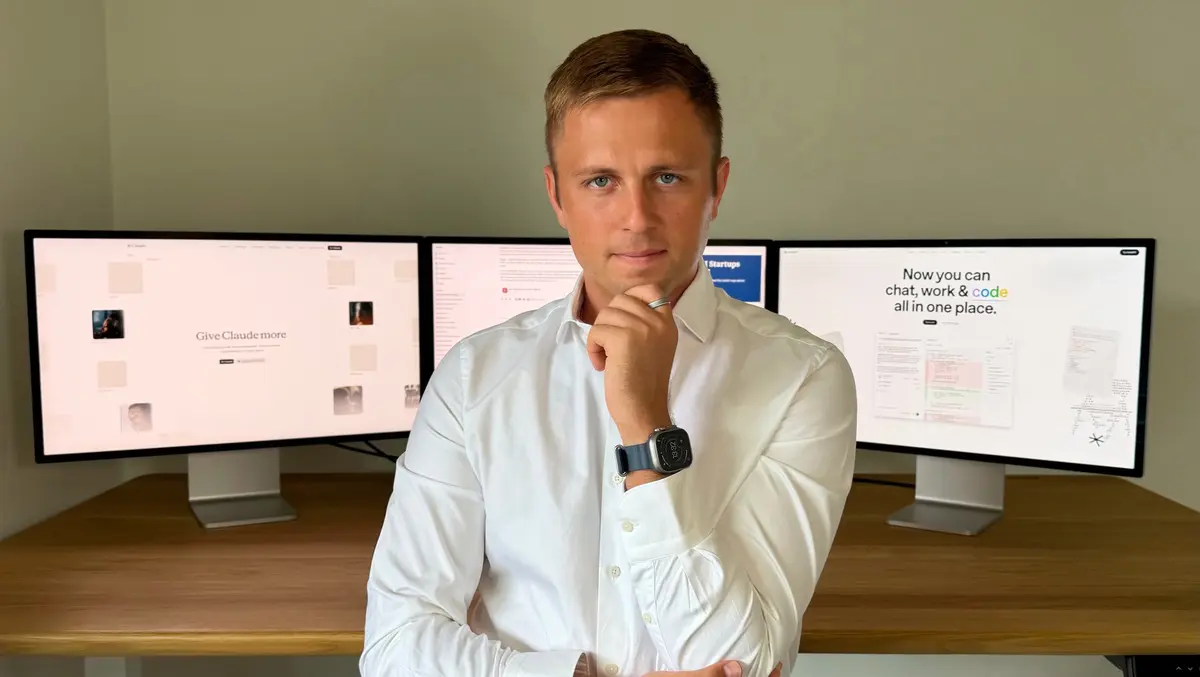
Use.ai was founded by Ihor Herasymov, who said the product grew out of his frustration with moving between separate AI services. Before launching the company, Herasymov worked in M&A and technology investment banking, started seven businesses, and later built a technology company to more than 100 employees and USD $3 million in annual revenue within two years.
He said his own use of AI tools exposed a problem for heavy users: as newer models appear, older services still hold valuable personal context.
"I pay around $1,000 a month for premium subscriptions because those accounts hold years of my history. My preferences, my work, my life. I don't want to lose that context whenever a better model appears," said Ihor Herasymov, Co-Founder, Use.ai.
"That's where Use.ai began: one account, leading AI models, and context that stays with you," he said.
Single workspace
Use.ai positions itself as a consumer workspace rather than a tool built primarily for software developers. The service lets people handle research, writing, planning and other tasks in one thread while switching models as needed.
At the centre of the offering is a free Answer Engine based on open-weights models configured by the company. Paid subscriptions provide access to more advanced models for tasks requiring deeper reasoning.
It is also working on automation that would route a task to the model it considers most suitable, reducing the need for users to track launches or compare benchmark scores themselves.
"We build for consumers, not developers," Herasymov said.
"Our users shouldn't need to follow model releases, compare benchmarks or decide which model is best for every task. That's our job," he said.
User behaviour
Use.ai cited survey data to support its view that users want flexibility in model choice. In a survey of more than 5,000 users, 42% said they switched models for better quality or deeper reasoning, while 36.5% changed models depending on the task.
It also pointed to a separate survey of more than 30,000 users, which found that 54% were either using AI for the first time or had only experimented with it a few times. That suggests a large share of the market remains in the early stages of adoption, even as competition among model providers intensifies.
The figures underline a broader issue in the AI market. As users spend more time with a service, their conversations, uploaded files and preferences become part of a growing personal archive, making it harder to move elsewhere even if a rival model performs better on some tasks.
Use.ai is trying to turn that tension into a consumer proposition by separating the user relationship from any single model provider. Rather than locking users into one AI system, it aims to keep the interface and accumulated context stable while the underlying models change.
Next phase
Its longer-term aim is to move beyond text responses into task completion. The company described a personal assistant that could use a person's preferences, calendar and connected apps to carry out practical actions such as booking appointments or helping with shopping decisions.
Examples included arranging a haircut based on a user's usual salon and availability, or researching running shoes, comparing prices and eventually completing a purchase after approval. Those plans place Use.ai within a broader industry push to make AI systems act across services rather than simply answer prompts.
The commercial challenge will be whether users trust a single consumer-facing platform to manage both their context and the handoff between multiple third-party models. The competitive challenge will be whether large model owners continue to support broad access through external interfaces while also trying to keep users inside their own products.
For now, Use.ai's user milestone suggests there is demand for a simpler route through an increasingly crowded AI market.
"Our goal is to minimize the effort between 'I need something done' and 'it's done,'" he said.
"We want Use.ai to be where your AI relationship begins and where it stays, regardless of which model wins next," he said.