

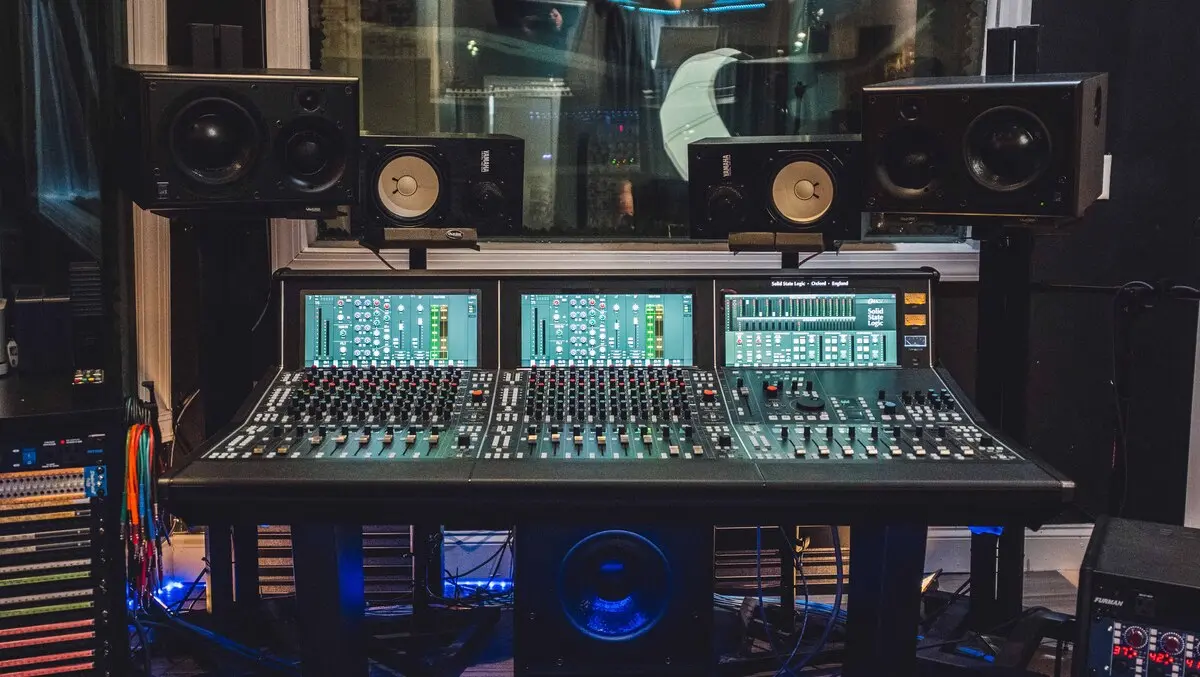
Arch Audio completes first Oracle tracking session
Thu, 14th May 2026
Arch Audio has completed what Solid State Logic described as the first commercial tracking session in the United States on an Oracle console. The session took place at the studio's facility in Chattanooga.
Studio owner, engineer and producer Mark Hutchinson installed the 48-channel Oracle desk at Arch Audio and quickly put it to use on a two-day recording project. The session featured country soul artist Tyson Leamon, Rock & Roll Hall of Fame inductee Willie Kitchens, former lead singer of The Impressions, and a full band.
The project served as an early real-world test of the new desk in a commercial studio setting. Hutchinson, who has worked in the industry for more than 35 years and opened Arch Audio in 2017, said the console's recall functions stood out during a session that moved between two songs with notably different setups.
"We did two full songs; there were big differences between them, but the instant recall just kept us in the zone," said Mark Hutchinson, owner, engineer and producer at Arch Audio.
He said the ability to restore analogue settings without a manual reset changed the pace of the session. In a tracking environment, that made it easier to move between arrangements without losing time.
"You don't have to worry about any of your analogue settings - everything just pops right back up. I didn't even have to think about it. The recall really is a big deal; it significantly enhances how the artists, engineer, and studio interact with the console," Hutchinson said.
Session workflow
Oracle combines analogue signal paths with digital control and recall. Solid State Logic said the desk includes 16 bus routing switches, integrated THE BUS+, a four-band E/G series parametric EQ and 10 auxiliary sends, all of which can be recalled across the console.
The system is designed to let engineers switch quickly between setups such as tracking, overdubbing and mixing. Hutchinson said that in practice it allowed him to stay focused on sound rather than resetting hardware between songs.
"I was just getting the tones that I liked," he said.
He also pointed to the way the console handles control surfaces. Each of the two eight-channel bays can be assigned to different banks of inputs, and the banks do not need to be contiguous. That gave him the option of placing selected sources directly under his hands without changing his listening position.
"With that flexibility, I could have the drums on channels one through eight, for instance, and on the second fader bank have, say, channels 25 to 32. There are two completely separate sets of banks of faders. DAW control could even be assigned to one of them, if I want ITB control on one side and full analogue control on the other; that's very powerful," Hutchinson said.
Hybrid control
The desk can also operate as a conventional in-line analogue console or as a controller for a digital audio workstation, with those roles assigned independently across the two eight-channel bays. Hutchinson said moving between the desk and Pro Tools was straightforward during the session.
"Switching back and forth between the DAW and the console is very easy. It's literally the touch of one button and you're pushing the Pro Tools faders. Hit it again, and now you're controlling the console," he said.
Display and labelling functions were another practical feature during recording. Channel names entered by the engineer appear both at the fader and on the meter bridge screens, reducing the risk of confusion in a large live session.
"You never have to wonder; you know what fader you're touching, because it's named right there in two places. It keeps you from making mistakes," Hutchinson said.
He also said he preferred the plasma-style metering option available on the display system.
"I prefer the plasma-style meters more so than the VU meters," he said. "They're just more vibrant, and they show you the levels at both the small fader and the large fader simultaneously."
Sound and design
Hutchinson said the first session involved committing heavily on the way into the recording system, using the desk's routing, inserts and processing while tracking the band and vocalists. Despite it being his first project on the new desk, he said the work went smoothly.
"We committed to a lot on the way in. Oracle's routing, processing, and inserts, sending from the small fader or large fader path and back again, was just seamless. The console is very easy to understand and very easy to operate," he said.
He was particularly positive about the sound of the preamps and EQ during the session, citing the studio's Yamaha C7 grand piano as one example.
"I've got a C7 grand piano and I can tell you for a fact, that's the best that piano has ever sounded. But everything - the guitars, the vocals, everything - really turned out pristine, which is a good word, and just right for that console. The PureDrive preamps on the console are just golden," Hutchinson said.
The Oracle's channel EQ can be switched between curves and Q characteristics associated with SSL's E series and G series desks. Hutchinson said he found himself responding to the sound rather than thinking about the underlying design.
"The EQ sounds absolutely amazing, but I was just getting the tones that I liked and not paying that much attention to the technical aspect of it. This is really when you know you're in front of a well-designed console with fifty years of dev behind it," he said.
He also highlighted the system's compact format, which places analogue components in a remote rack rather than under a large-format desk surface.
"A 48-channel console, especially one with up to 112 inputs at mixdown, is normally 10 or 12 feet long. So, to be able to have the insight to put all the analogue components in a remote rack and make the footprint of the console smaller is just brilliant," Hutchinson said.