

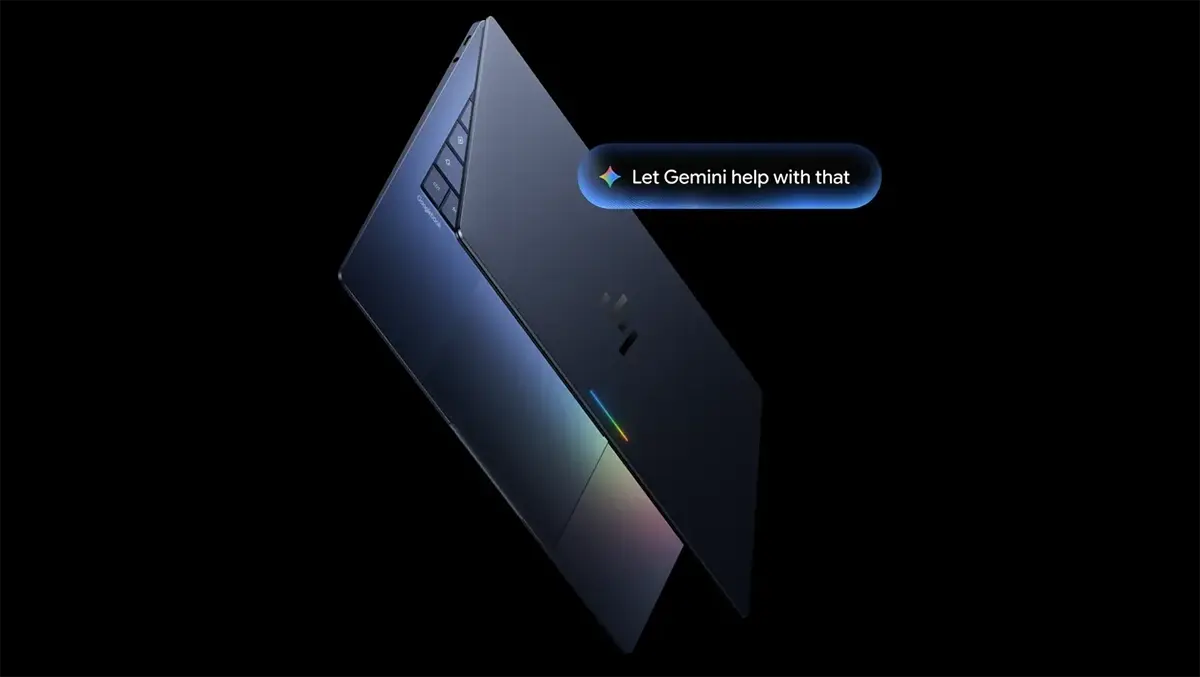
Google launches Googlebook laptop with Gemini built in
Tue, 22nd Sep 2026 (Today)
Google has launched Googlebook, a new laptop with Gemini built into the device. The machine starts at USD $899.
Googlebook combines new software features with access to Gemini tools already available in Chrome and Android, including task automations, Gemini Live and on-screen suggestions. It also includes what Google calls Gemini Spark, which can continue processing requests while the laptop is closed.
The launch marks a broader push by Google to place its artificial intelligence tools at the centre of personal computing hardware, rather than keeping them primarily in browsers, mobile apps and cloud services. The laptop is being presented as a system that can interpret text, images and spoken language directly within everyday workflows.
One of the main additions is Magic Pointer, a feature that appears when a user wiggles the cursor. It can understand text, images and context at the point where a user is working, allowing prompts to be issued without switching to a separate app or window.
Google's examples include highlighting a training plan on a web page and asking Gemini to schedule runs in Google Calendar, or hovering over a suspicious email and asking whether it is spam. Users can also select images and ask the system to combine or visualise them together.
Magic Pointer remains inactive until a user summons it with a cursor movement. Google presents that design as a privacy measure intended to keep the feature off when it is not being used.
Voice tools
Another feature, called Rambler, is designed to go beyond conventional dictation by reorganising spoken input rather than transcribing every word exactly as said. The tool can remove filler words and mistakes, turn spoken notes into structured bullet points and work across multiple languages in the same sentence.
Google positions Rambler as a way to capture rough verbal thoughts and convert them into more usable written material. In its example, a user drafting team meeting notes can speak freely while the system organises action items and formats the output.
Custom widgets
Googlebook also includes Create My Widget, a tool that lets users build widgets by describing what they want in plain language. Examples include a score tracker for a sports team and a visual countdown for a family trip.
For users who want more direct software control, every Googlebook comes with Antigravity, which can be used to write apps and deploy them to the device. Developers also get access to a Linux terminal environment for tools including Claude Code and Antigravity CLI.
That combination suggests Google is trying to appeal both to mainstream buyers and to technical users who want a laptop that supports local development work alongside consumer-facing AI features. By bundling a terminal with consumer software tools, it is blurring the line between a productivity laptop and a development machine.
Bundled services
Each Googlebook comes with 12 months of Google AI Pro, which includes 5TB of cloud storage and higher usage limits in Gemini. Buyers also receive three months of YouTube Premium, Adobe Photoshop and other services.
Googlebook OS will receive regular feature updates for up to 10 years. That commitment aligns the device with a wider industry shift towards longer software support periods, which have become an increasingly important part of laptop and smartphone buying decisions.
The hardware enters a market where manufacturers are racing to define what an AI laptop should be. Rivals have added dedicated chips, software assistants and new branding around on-device machine learning, but product differentiation has often been unclear for buyers deciding whether the additions offer practical value in daily use.
Googlebook's approach appears to focus less on chip marketing and more on tying AI functions directly to routine laptop actions such as moving a cursor, speaking notes, creating widgets and managing background tasks. That could help Google stand out if users see those tools as reducing friction rather than adding another layer of software to learn.
Pre-orders have opened through the Google Store, Best Buy and selected retailers, with the first retail launches planned across the US, Canada, the UK, Ireland, France, Germany and Australia.